Hydronic vs Electric Snow Melting: Which Fits Your Driveway?
Hydronic vs electric snow melting is the first choice to make when you plan a heated driveway or walkway. Either way, the surface clears itself while the rest of the street is still shovelling, which can change how winter feels at home.
There are two main ways to do it: hydronic tubing that circulates warm fluid, and electric cables. Here is how they compare.
How each system works
Hydronic
Loops of PEX tubing are laid in the base under the surface. A boiler heats a glycol-water mix that is pumped through the loops, warming the slab from below. The boiler can be a dedicated unit or, in some homes, part of an existing hydronic heating system.
Electric
Heating cables or mats are set in the bedding layer or slab and connected to a dedicated circuit and controller. Electricity heats the cables directly, with no boiler, pump or fluid.
Hydronic tubing (left) and electric cable (right), both installed before the surface goes down.
Side-by-side
•Best for: hydronic suits large areas like full driveways; electric suits smaller areas like steps, walkways and tire tracks.
•Upfront cost: hydronic is higher because of the boiler and mechanical parts; electric costs less to install on small areas.
•Running cost: depends on local gas and electricity rates; hydronic using natural gas is often cheaper to run over large areas.
•Equipment: hydronic needs space for a boiler, pump and manifold; electric needs electrical capacity in the panel.
•Maintenance: hydronic has a boiler and pump to service; electric has few moving parts.
•Response: both are usually run by a controller with a snow and temperature sensor, so they switch on when needed.
Controls make the difference
Running a snow-melt system all winter is expensive. Modern systems use an automatic controller with a snow/moisture and temperature sensor: it turns on when it detects precipitation near freezing and switches off once the surface is clear and dry. Some systems also keep the slab at an idle temperature so it reaches melting faster. Good controls are what keep operating costs reasonable.
Steps and entrances are where heated systems do the most for safety.
Choosing the surface on top
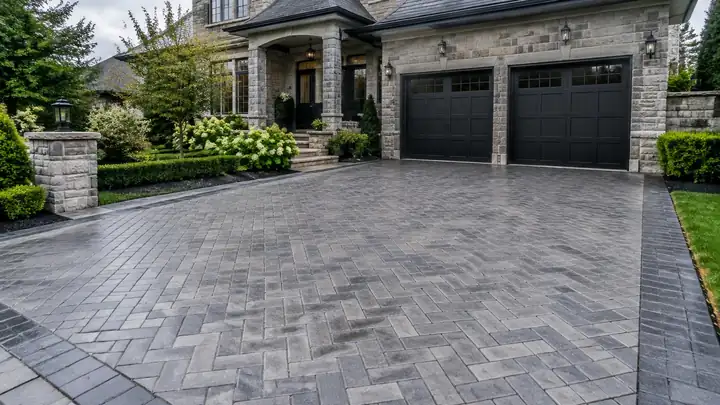
Snow-melt works under interlocking pavers, natural stone and concrete. The surface and the base need to be designed together, because the tubing or cable sits within specific layers and must be protected during compaction. It also means a heated system is far easier to add when a driveway or walkway is being rebuilt than to retrofit under an existing surface.
Planning considerations
✓Which areas truly need heat: the whole driveway, or just tire tracks, walks and steps?
✓Where meltwater will drain, so it doesn't refreeze at the bottom of the slope.
✓For hydronic: where the boiler and manifold will go, and how the lines reach the driveway.
✓For electric: whether your panel has capacity, and the permit for the new circuit.
✓All electrical work in Ontario requires an ESA permit and a licensed electrical contractor.
Installing during a rebuild is the simplest and most reliable way to add snow melting.
Common questions
Can a snow-melt system be added under an existing driveway?
Generally the surface has to come up, because tubing or cable sits within the base layers. Pavers can sometimes be lifted and reused. That is why the best time to add heat is during a rebuild.
Does a heated driveway handle heavy snowfalls?
Systems are designed to melt snow as it falls at a certain rate. In a very heavy storm, snow can build faster than it melts, but it clears without shovelling once the storm eases. Pre-heating ahead of a storm helps.
Can I heat just part of the driveway?
Yes. Heating tire tracks, the walkway and front steps is common. It costs less to install and run while covering the places you walk and drive.